
Son İki F-16 Blok 70 Savaş Uçağı Bulgaristan'a İnerek Hava Kuvvetlerinin Önemli Dönüm Noktasını İşaretledi
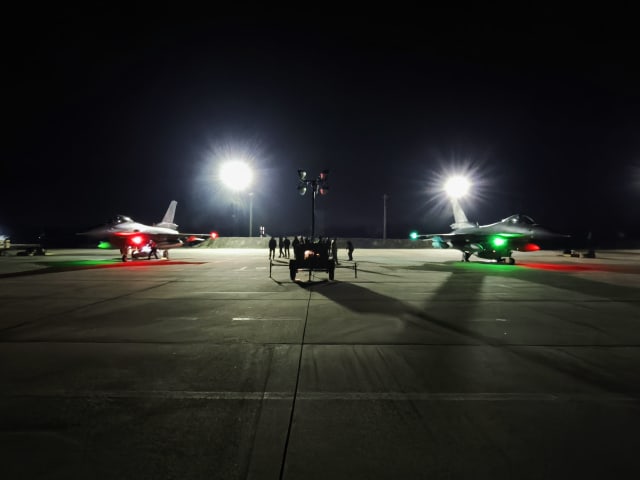
The final two F-16 Block 70 fighter jets included in Bulgaria’s first contract with Lockheed Martin Aeronautics arrived in the country on December 16, completing the initial delivery phase. Defense Minister Atanas Zapryanov and Chief of Defense Admiral Emil Eftimov welcomed the aircraft upon landing at the Third Air Base at around 8:00 p.m.
The two aircraft, one single-seat and one two-seat, arrived bearing the markings of the United States Air Force. After their arrival, these insignia will be replaced with those of the Bulgarian Air Force. With this delivery, Bulgaria now has a total of eight F-16 Block 70 fighters. The event was also attended by the Deputy Commander of the Air Force, Brigadier General Dimitar Georgiev, the acting commander of the Third Air Base, Colonel Metodi Orlov, as well as representatives of the US Air Forces in Europe and Africa and the US Embassy in Sofia.
Once the remaining eight aircraft under the second contract with Lockheed Martin are delivered, the Bulgarian Air Force will be able to form a full F-16 Block 70 squadron. Lockheed Martin has meanwhile confirmed that it has completed production of all F-16 Block 70 jets ordered by Bulgaria and Slovakia. The announcement was made on December 15, 2025, marking the end of production for the first squadrons for both countries at the company’s Greenville, South Carolina facility under the US Foreign Military Sales program.
The conclusion of production closes two long-running modernization programs aimed at replacing the ageing MiG-29 fleet and aligning the air forces of Bulgaria and Slovakia with NATO standards. This development comes against the backdrop of the ongoing war in Ukraine, which continues to increase pressure on NATO’s eastern flank and underlines the importance of securing airspace over Central and Southeastern Europe.
Operationally, the F-16 Block 70 provides Bulgaria and Slovakia with multirole aircraft capable of air policing, defensive air defense, and precision strike missions. The jets can use a wide range of NATO-standard air-to-air and air-to-ground munitions and are fully integrated into the shared data, training, and operational environment used by other European F-16 operators.
For Bulgaria, the completion of production reflects the outcome of two contracts signed in 2019 and 2022 for a total of 16 aircraft. These acquisitions were intended to replace MiG-29s that had become increasingly difficult and costly to maintain. Delivery schedules were affected by the pandemic and global supply chain disruptions, forcing Bulgaria to rely on allied air forces to support air policing missions over its territory.
The arrival of the new fighters is expected to gradually restore Bulgaria’s ability to independently carry out rapid reaction and airspace protection tasks, while also enabling more consistent participation in NATO air policing missions, including those linked to security in the Black Sea region.