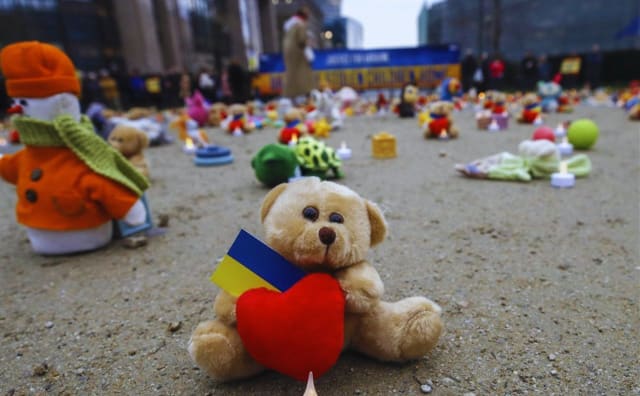
BM Genel Kurulu Rusya'dan kaçırılan Ukraynalı çocukların iadesini talep etti
The UN General Assembly has approved a resolution calling for Russia to immediately and unconditionally send back all Ukrainian children who were taken from their families during the war. The document passed with the support of 91 member states. Twelve countries voted against it, including Russia, Belarus, Iran, Nicaragua, Cuba, Eritrea, Mali and several others, while 57 abstained. Among those who did not take a side were China, India, Brazil, Armenia, Kazakhstan, Kyrgyzstan, Uzbekistan, Egypt, Qatar and Pakistan.
During the presentation of the resolution, Ukraine’s Deputy Foreign Minister Mariana Betsa underscored that the issue has nothing to do with politics and is instead a matter of basic human decency. She warned that children have become the most defenseless victims of Russian aggression. According to her, Russian authorities are not only responsible for killing and injuring minors but are attempting to erase their cultural identity. In the territories occupied by Moscow and inside Russia itself, Ukrainian children are barred from learning their language, literature and history and are exposed to propaganda designed to impose a distorted narrative about their country. Many are encouraged to repeat claims portraying Ukraine as a so-called Nazi state and are funneled into youth formations where they undergo military-style training and ideological conditioning.
Ukraine’s Foreign Ministry estimates that more than 20,000 children have been forcibly taken since the full-scale invasion began in February 2022. So far, only 1,850 have been brought back. UN General Assembly President Annalena Baerbock noted that the deportation of children violates fundamental principles of international humanitarian law. She recalled that Article 49 of the Fourth Geneva Convention strictly forbids any transfer of civilians from occupied areas, while the Convention on the Rights of the Child guarantees basic rights such as identity, family connections, citizenship and protection from abduction. Baerbock stressed that returning the children cannot be separated from the broader context of Russia’s invasion and noted that the General Assembly has been forced to act whenever the UN Security Council remains unable to take decisions because of Russia’s stance. She emphasized that the renewed session aims to defend international norms and protect Ukraine’s population, especially minors caught in the conflict.
Diplomats supporting the resolution stated that backing the document means defending justice and creating mechanisms to ensure that abducted children can eventually return home.
New information presented to the U.S. Senate further illustrates the scale and severity of the problem. Kateryna Rashevska, a legal expert at Ukraine’s Regional Center for Human Rights, told American lawmakers that there have been documented cases of abducted children being sent as far as North Korea. She cited two examples: a 12-year-old boy from the occupied part of Donetsk region and a 16-year-old girl from Simferopol, both transferred to the Songdowon camp nearly 9,000 kilometers from their homes. According to her testimony, children in that facility were exposed to militant propaganda, including instructions on attacking “Japanese militarists”, and met North Korean veterans involved in the 1968 assault on the U.S. Navy vessel Pueblo.